Understanding EBSA
When school feels too hard, it isn't defiance
Emotionally Based School Avoidance is a way of describing severe difficulty attending school linked to emotional distress rather than choice.
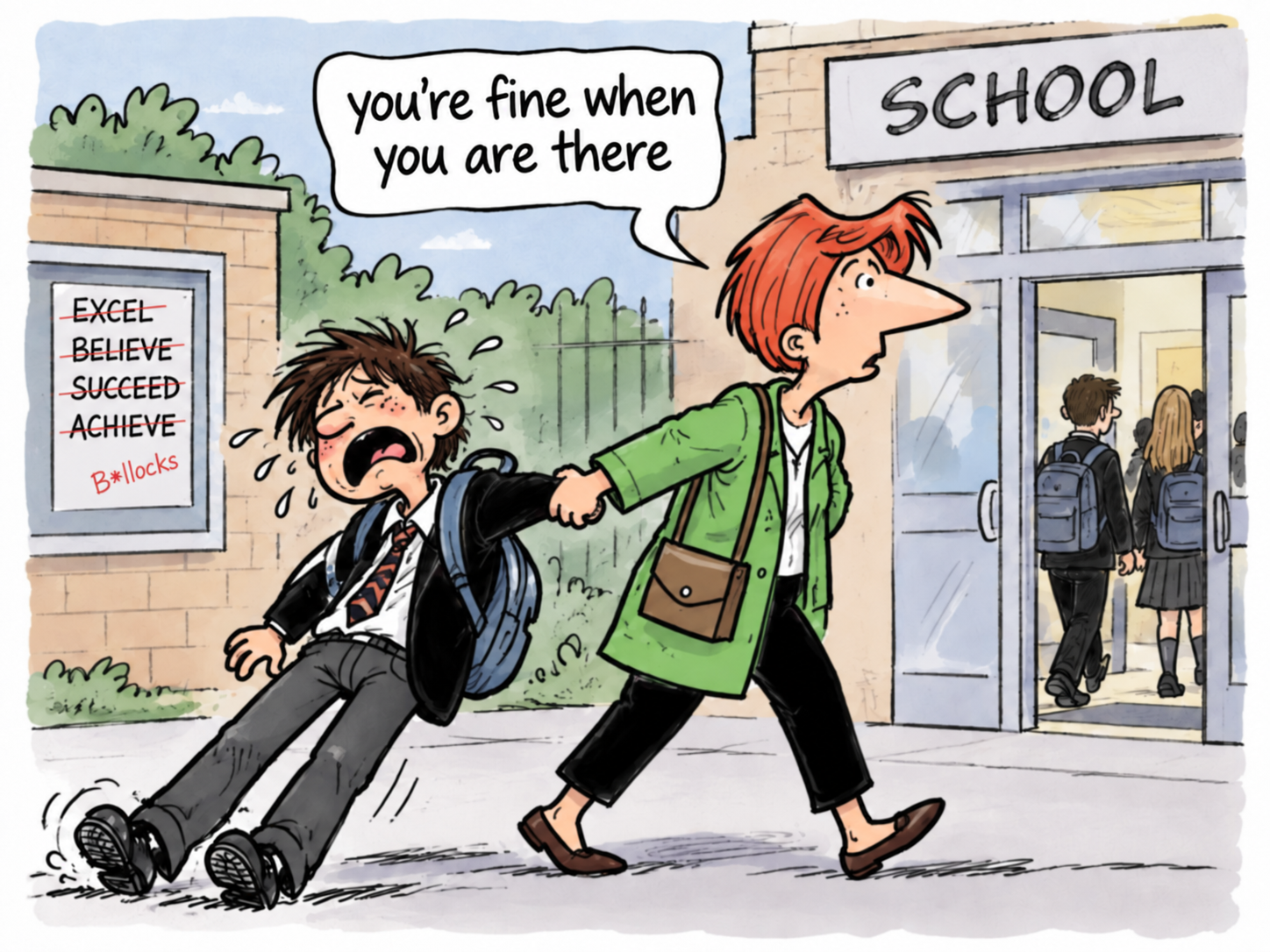
EBSA isn't defiance. It's a young person doing the only thing that makes the fear stop for a while.
EBSA is a minefield. And I don't say that lightly.
I've worked inside this system. I've sat in local authority meetings, worked alongside attendance teams and schools, and seen first-hand how quickly families can find themselves caught between a young person who genuinely cannot manage school and a system that still has statutory attendance duties to deal with.
Here's part of the problem: EBSA is widely recognised as a description of emotionally driven difficulties attending school, but it isn't a single statutory absence category.
That means what is happening emotionally and what gets recorded on an attendance register are not always the same thing. And that is where things can get very confusing, very quickly.
My job and my expertise helps you navigate it properly.
- Rebuild communication with school
- Understand what support and adjustments are actually realistic
- Gather the right supporting evidence where it is needed
- Work towards a plan that supports your young person without turning every email from attendance into a minor cardiac event
I'm pro-collaboration. Schools matter. Relationships with them matter. But I also know the system well enough to help you challenge things appropriately when you need to.
EBSA is complicated.
You do not have to navigate it alone.
What is EBSA?
EBSA stands for Emotionally Based School Avoidance. It describes a young person who finds it extremely difficult, sometimes impossible, to attend school because of anxiety, worry or emotional distress. It isn't truancy, and it isn't laziness. Most young people experiencing EBSA very much want to attend; their brain simply reacts to school as if it were a threat. But it is rarely school that is the threat, it is the tiny micro parts about the school day that are thrown into a pot to make a cauldron of absolute chaos for your young person.
The causes are usually a mix: anxiety, friendship difficulties, sensory overwhelm, unmet learning needs, bullying, transitions, changes at home, or a long absence that became harder and harder to break. Because the causes are layered, the solution needs to be layered too, and that's what I do.
School avoidance rarely starts with “I’m not going.”
Usually, it’s been building for a while.
A bellyache on Monday.
A headache on Wednesday.
Period pains. Toothache. Feeling sick. Exhausted. A sore ankle. A dodgy toe. A metatarsal that apparently may never recover from PE.
And because you’re a parent — you deal with the problem.
Painkillers. GP appointment. New shoes. Lift to school. Email the teacher. Later start. Skip PE.
Barrier removed.
Excellent.
Except… somehow there’s another one waiting behind it.
Then another.
And another.
Until you start feeling like you’re playing the world’s most stressful game of Whac-A-Mole.
You solve one perfectly genuine problem and something else becomes the reason they just can’t go in today.
And then one morning, there isn’t another barrier to solve.
They simply cannot get through the door.
That can feel like it happened overnight.
Often, it didn’t.
“But school have put everything in place…”
This is where it gets even more confusing.
School might offer a later start, a safe space, reduced timetable, trusted adult, time-out card or somewhere quiet at lunch.
On paper?
Bloody brilliant.
But your young person still can’t go.
Because a reasonable adjustment is only useful if it removes the barrier your young person is actually struggling with.
And sometimes the plan gets picked apart before they’ve even left the house:
“What if that teacher isn’t there?”
“What if someone asks why I’m late?”
“What happens when I have to go back into class?”
“Where do I go at lunch?”
“What if everyone looks at me?”
Suddenly, the amazing plan has 14 loopholes and you’re back at square one.
This is why we need to understand what is underneath the avoidance — not just keep trying to get them through the school gates.
Because by the time school has become impossible, the story usually started much earlier.
 helps you work backwards, figure out what the hell is actually going on, and start building a way forward.
You don't have to work this out alone
I'll help you understand what's driving the anxiety and build a realistic plan with your child's school.
Book an initial conversation